
Organic Strawberry Fields Forever:
From Start to Finish
Organic agriculture is rightfully known as an important contributor to combatting a wide range of global human health and environmental problems. It protects our air, land and water by eliminating the most poisonous chemicals from agriculture and by using substantially less fossil fuel than conventional industrial agriculture. Organic practices mitigate the adverse effects of climate change by sequestering carbon, improving soil water-holding capacity, and regulating soil temperatures so crops can survive droughts, floods, and extreme temperatures. But, all aspects of organic systems are not perfect. That is why drafters of the Organic Foods Production Act (OFPA) allowed ample room for continuous improvements. An area still in need of improvement is the development of organic nursery planting stock (starts).
Organic Strawberry Industry Dilemma
Sought after as a tasty, healthy, nutrient-dense food, organic strawberries contribute to both environmental degradation and protection. That is because all commercial organic strawberry farmers grow their fruit from conventional starts. Even though their land and growing practices are certified organic, organic strawberry farmers must purchase conventional starts grown in soils that have been injected (fumigated) with highly toxic pesticides to kill pests – they have no other option. Until the launch of the Organic Strawberry Fields Forever Project, there were no commercial organic strawberry nurseries in the entire U.S. Organic Advocacy is leading the charge to stimulate the development of new organic nurseries and to assist the organic strawberry industry in transitioning to organic starts.
An estimated 80 million organic starts are needed to transform the entire organic strawberry industry in California once organic starts become the norm in California,1 ending the organic strawberry industry’s contribution to the associated health, environment, and climate warming impacts.
No Organic Strawberry Transplants?
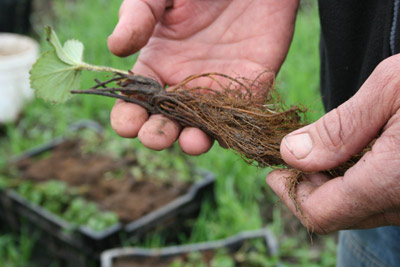
The lack of organic starts has put organic strawberry farmers in a difficult position of being forced to farm with conventional starts. USDA’s National Organic Program has allowed this practice to continue, virtually unchecked, under the organic regulation’s “commercial availability” clause. The clause was intended to facilitate organic starts and seeds development, but that has not happened in the organic strawberry sector. Since regulations do not mandate a deadline for eliminating conventional starts, no market pressure or incentives exist to stimulate organic production. In fact, for over 28 years since the passage of OFPA, organic strawberry farmers have used conventional starts – because they have no other choice!
Methyl Bromide and Organic Strawberries?
Fumigating soils to combat pathogens, insects, and weeds with methyl bromide (MeBr) and the chemical warfare agent, chloropicrin, became the standard strawberry nursery practice in the 1950s. But their use carried a high social cost. MeBr gas has 5 times the global warming potential of carbon dioxide. Its release from farms has caused 5-10% of world’s ozone depletion,3 adding $93.6 million to the state’s economy.4 Their farm fields occupy 4,170 acres — which more than doubled in the past 5 years — representing 13.1% of California’s total strawberry acreage.5 Expanding production of public varieties of organic strawberry starts presents a tremendous, unmet market opportunity that is essential for transforming the industry, nationwide.
The goal of this farmer-led project is to transition California’s organic strawberry industry away from using conventionally grown, chemical-intensive starts to exclusively using organic starts.
Game Plan:
- Facilitate the development of public varieties of organic strawberry starts at nurseries at multiple locations.
- Coordinate field trial data collection and analysis, farm tours and widespread publication of results.
- Inform consumers about the positive changes underway in organic strawberry production.
- Outreach to organic strawberry farmers to enlist them to grow organic starts and help transition the industry!
Given the continued and rapid growth of the organic strawberry industry, OSFF’s success will make a positive and measurable environmental and health impact by reducing the use and release of ozone-depleting, toxic, soil fumigants.
Funded By:
- CCOF Central Coast Chapter
- Center for Food Safety
- Organic Farming Reseach Foundation
- Straus Family Creamery
- Bolda, M. UC Cooperative Extension, Strawberry and Caneberry Farm Advisor. Personal Communication. Nov. 29, 2016
- https://www.epa.gov/ozone-layer-protection/ozone-depleting-substances
- Based on 34,000 pounds average yield per acre. Bolda M. et al. (2014) UC Cooperative Extension.
- Klonsky & Healy. (2013) http://aic.ucdavis.edu/2013/10/01/statistical-review-of-californias-organic-agriculture-2009-2012/
- CA Strawberry Commission. (2019) “California Strawberry 2019 Acreage Survey.”